“Art in Nigeria 1960” by Ulli Beier, Cambridge University Press, 1960
The Contemporary Nigerian Artist
While the present generation of traditional wood-carvers and bronze-workers is still active in the villages of Nigeria, there exists side-by-side with them a new type of artist who resembles far more the individualist artist we associate with modern Europe and America. These younger artists are usually highly educated in the Western sense; they have often received training in London art schools and they exhibit in London and Paris galleries. Two of them, Ben Enwonwu and Felix Idubor have gained a considerable reputation abroad. These artists are pioneers in the truest sense of the word, and their position in society is by no means an easy one.
The new Nigerian middle class to which they belong is not particularly interested in the arts at the moment. These are turbulent days of rapid political develop-ment and economic growth, and art is considered to be something of a luxury. It is often said that the needs of Nigeria at the moment are roads, schools and hospitals rather than art and music. Art, in other words, is thought of as some kind of entertainment that it is good to have, if one can spend the time on it. Such a time might come in the distant future after indepen-dence, but at the moment there are more urgent things to do. In other words the artist is no longer considered to be an essential member of the community as he used to be in traditional African society.
The Nigerian artist therefore depends largely on Europeans for his public. But European collectors and art lovers do not form an ideal public for him. They are brought up to admire and love traditional African art and they would like the modern African artist to continue a tradition and to be inspired by the works of their fathers. They are disappointed when they see tht the contemporary African artist is less interested in African traditions than in European ones …
Commercial art in Nigeria
The greatest problem of the serious modern artist is his isolation. As in Europe, the intellectual African artist finds himself understood only by individuals. The mass of the people seem to have no need of him and seem to go through life without even having heard of him. How many Nigerians have been to an exhibition of, say, Felix dubor? How many own a painting by Ben Enwonwu or Afi Ekong? The importance of an artist depends of course solely on the quality and sin-cerity of his work, not on the quantity of his admirers. But it is a serious situation for society when life and art have drawn apart…
African carving and modern architecture
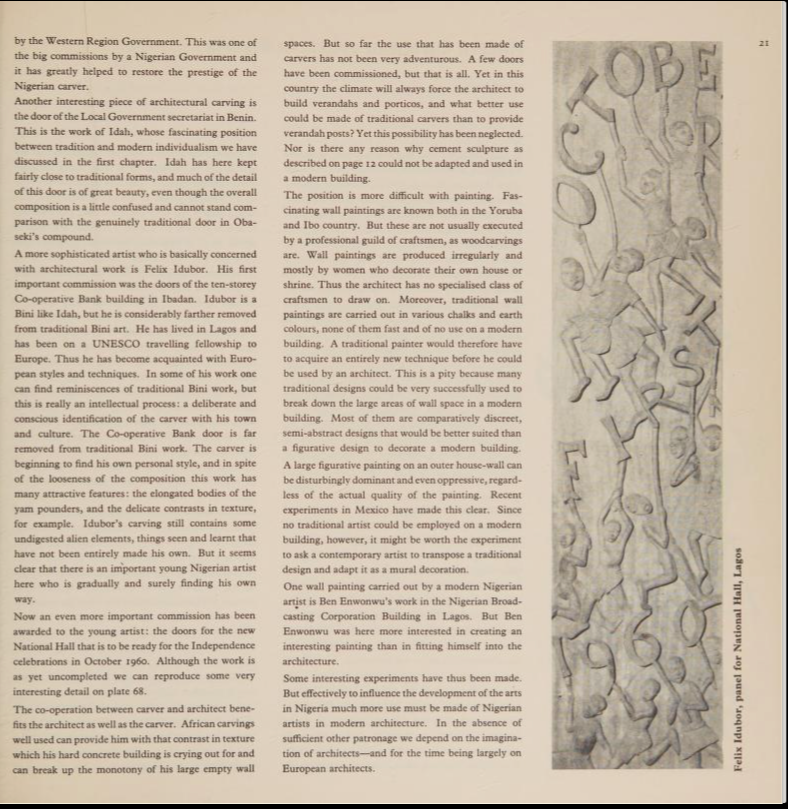
…A more sophisticated artist who is basically concerned with architectural work is Felix Idubor His first important commission was the doors of the ten-storey Co-operative Bank building in Ibadan. Idubor is a Bini like Idah, but he is considerably farther removed from traditional Bini art. He has lived in Lagos and has been on a UNESCO travelling fellowship to Europe. Thus he has become acquainted with European styles and techniques. In some of his work one can find reminiscences of traditional Bini work, but this is really an intellectual process: a deliberate and conscious identification of the carver with his town and culture. The Co-operative Bank door is far removed from traditional Bini work. The carver is beginning to find his own personal style, and in spite of the looseness of the composition this work has many attractive features: the elongated bodies of the yam pounders, and the delicate contrasts in texture, for example. Idubor’s carving still contains some undigested alien elements, things seen and learnt that have not been entirely made his own. But it seems clear that there is an important young Nigerian artist here who is gradually and surely finding his own way.
Now an even more important commission has been awarded to the young artist: the doors for the new National Hall that is to be ready for the Independence celebrations in October 1960. Although the work is as yet uncompleted we can reproduce some very interesting detail on plate 68.
The cooperation between carver and architect benefits the architect as well as the carver. African carvings well used can provide him with that contrast in texture which his hard concrete building is crying out for and can break up the monotony of his large empty wall spaces …
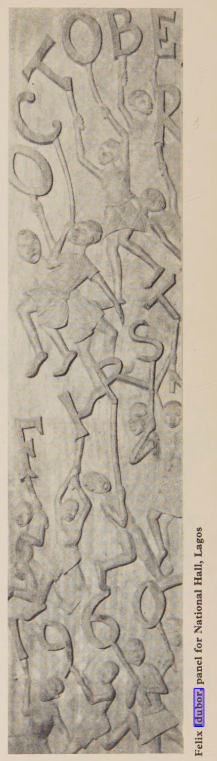
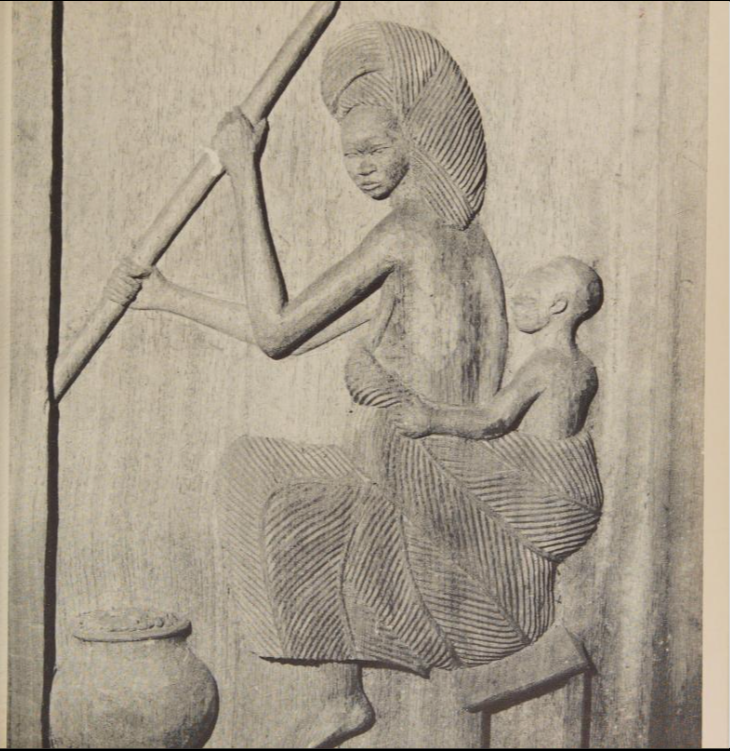
Felix Idubor, a more sophisticated Bini carver, created the door panels for the National Hall in Lagos (plate 68).
