AFRICAN SCULPTURE
THE WORK OF MR. FELIX IDUBOR
FROM OUR ART CRITIC
The Times, July 18, 1957
African sculpture has certain inestimable virtues in European eyes, and European taste is inclined to be distinctly plus royaliste que le roi when it sees some young African artist letting slip any part of his great, inherited tradition. Mr. Felix Idubor, a Nigerian sculptor whose carvings are being shown at the Imperial Institute, South Kensington, until July 28, is self-taught and extremely conscious of his artistic, as well as his historical, background, but there are enough indications of European sophistication in his style partly to divorce his work in spirit from the fully African elements which are its subject.
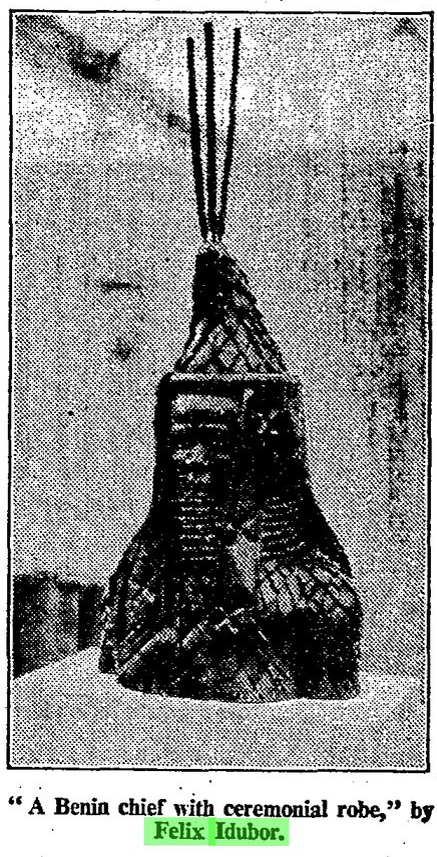
Mr. Idubor comes from Benin City, which bears a name renowned in Europe for its powerful and often highly elaborate sculpture, and particularly for its representations of the Oba in his distinctive robes and head-dress of beads which bear some resemblance to medieval armour. These appear again in Mr. Idubor’s work. Carving mostly in native woods such as ebony, the reddish iroko or pale yellow obeche, he re-creates a number of the traditional costumes and ornaments, figures from the history, religious, or social life of ancient Benin, and a series of masks which make use of accepted African stylizations for the features.
The consciousness of tradition in the conception of all these sculptures is very strong, but it is the consciousness of an artist who is only in part working from within the tradition (as in the case of small standing figures such as the “Drummer”) and for the rest of the time can only admire or follow its conventions. The most “African” in style of the works on view – the masks – are also those which indicate most clearly that an artist in an emergent society aware of European ideas can only with extreme difficulty, if at all, use again the idiom of the savage and not caricature the expressiveness in which its virtue lay.
Mr. Idubor’s best work in this exhibition is in a vein of faithfully representational naturalism. It has led him, in historical subjects such as the curious maquette of the Oba Ewuakpe burying his wife alive, to favour accuracy in an almost pedantic fashion, but his heads are almost uniformly good. Negro features, as Epstein has taught us, lend themselves naturally to sculptural representation.