African Art: The Years since 1920 by Marshall W. Mount, 1989
Introduction
The Nigerian sculptor, Felix Idubor, has not been active for some time. He has moved back to his birthplace, Benin City, where he operates a large art gallery.
Chapter 4: The Emergence of a New Art: Introduction
As previously mentioned, European and American businesses in Africa are becoming increasingly important as patrons of contemporary African art. Concerns with offices in major African cities have begun, often in conjunction with architects, to incorporate this art into their new buildings. Since many of these modern buildings are severely functional in appearance, art frequently relieves their stark simplicity, often providing a contrast of texture and materials. The use of art, in addition to its aesthetic function, creates a favorable impression among the peoples and governments of the strongly nationalist African states. Although discussed more fully elsewhere in these pages, a few of the outstanding examples of the work commissioned by these business firms should be mentioned briefly here: carved doors by Sam Songo for the Wankie Colliery in Rhodesia, carved doors for the Co-operative Bank in Ibadan by Felix Idubor, and a large pierced concrete relief by Festus Idehen and Paul Mount, commissioned by the Chase Manhattan Bank for what is now a branch of the Standard Bank of Nigeria in Lagos…
… The Ghanaian and Nigerian governments have frequently commissioned art for public buildings and facilities. Among Ghanaian works, Kofi Antu-bam’s carved doors and state chair in Parliament House in Accra and the bronze fountain figures by Vincent Kofi outside that city’s State House are most notable. Antubam also decorated dining rooms in the government owned Black Star Line ships and in the Ambassador Hotel in Accra. Nigerian government buildings are often similarly embellished. The National Parliament in Lagos, for example, has doors carved by Felix dubor: the Western Region House of Assembly in Ibadan contains the previously mentioned speaker’s table and chairs carved by Lamidi Fakeye; and the new Lagos City Hall is decorated with mosaics by Yusuf Grillo and a monumental carved wood partition by Festus Idehen. Ben Enwonwu, art adviser to the govern ment, has executed a number of works for the state, among them a bronze. full-length portrait of Queen Elizabeth, which stands before the National Parliament, and a similar study of Nigeria’s former president Dr. Nnamdi Azikiwe, which before the Civil War stood in front of the Eastern Region House of Assembly in Enugu.
Chapter 7: Art Schools in English-Speaking West Africa
Osagic Osifo, like Idehen, is a sculptor trained at Yaba Technical Institute. He was born in 1939 in Idumu Omwana, a village thirty miles from Benin City. He also derives from an artistic environment: the name of his village means “craftsmen of the king.” Apparently those who specialized in carving resided there and Osifo has said that consequently he began his career carly. He moved to Lagos in 1953, where his elder half brother, the well known Nigerian sculptor Felix dubor, further trained him (see below). Four years later Osifo entered the Yaba school, where he began a close association with Paul Mount, who had a major influence on his style. Upon his graduation from Yaba he opened a studio and salesroom in Lagos.
Chapter 8: Artists Independent of African Art Schools
AMONG twentieth-century African artists there are some who have had little or no connection with African art schools. A few are self-trained, while others have studied overseas. Some of these artists have full-time jobs in such varied fields as medicine, advertising, and government service and can devote only part of their time to art. A very few, however, such as Felix Idubor and Gerard Sekoto, support themselves solely from sales of their works. While the majority of these artists are from English-speaking areas, several come from other regions of Africa…
…The sculptor Felix Iduboris is another well-known independent Nigerian artist. He was born in 1928 in Benin City, where at the age of twelve he was already earning his living by woodcarving. Subsequently he became a member of the Benin Carvers Association, a group of souvenir-producing craftsmen in Lagos. In 1945 he established an independent workshop in that city to produce ebony heads for tourists. Idubor was discovered by (Ben) Enwonwu in 1951, and with the latter’s encouragement gave up souvenir-style carving for more creative work. Two years later the British Council in Lagos gave him his first one-man show, and from then on he exhibited frequently in Nigeria. Scholarships enabled him to travel in Europe in 1957. to study the following year at the Royal College of Art in London, and to study in Germany in 1962.
Idubor has executed numerous commissions in Nigeria for the government, for European business firms, and for individuals. Of major importance are the doors for the Parliament or National Hall in Lagos. He has also carved doors for the Oba’s palace in the same city, and, a typical modern African contrast, for the skyscraper headquarters of the Co-operative Bank in Ibadan. He has often been commissioned by the government to produce state gifts for visiting dignitaries, such as the casket given to Queen Elizabeth II. Many of his sculptures have been purchased by collectors from Europe and the United States.
Although Idubor has cast works in concrete and bronze, he is primarily a woodcarver. He uses the traditional African carver’s adzes and knives, which, in traditional fashion, he makes himself. He also uses European-made chisels. Employing no preliminary sketches, he works deftly and quickly, producing more than a hundred works a year.
Among Westerners. Idubor’s best-known works are his carved heads, idealized portraits of Nigerian peoples. They closely resemble souvenir-style ebony busts and represent, in fact, a continuance of Idubor’s early training and career. Idubor’s carvings of this kind, however, have more strength and vitality than the busts usually made for the tourist market, since they are not as detailed in treatment and their surfaces are vigorously animated with tool marks.
Idubor constantly experiments with new styles. He has carved several extraordinarily elongated wood figures which were inspired by photographs shown to him by Americans of works of the late Swiss sculptor Giacometti. More interesting are several highly stylized pierced figures whose most obvious stylizations are overall flatness, substitution of a smooth, shallow depression for the facial features, and above all, the piercing of the upper torso and cars. These particular stylizations, although frequent in modern European sculpture, particularly in the work of Archipenko, Zadkine, and Moore, are unique in African art.
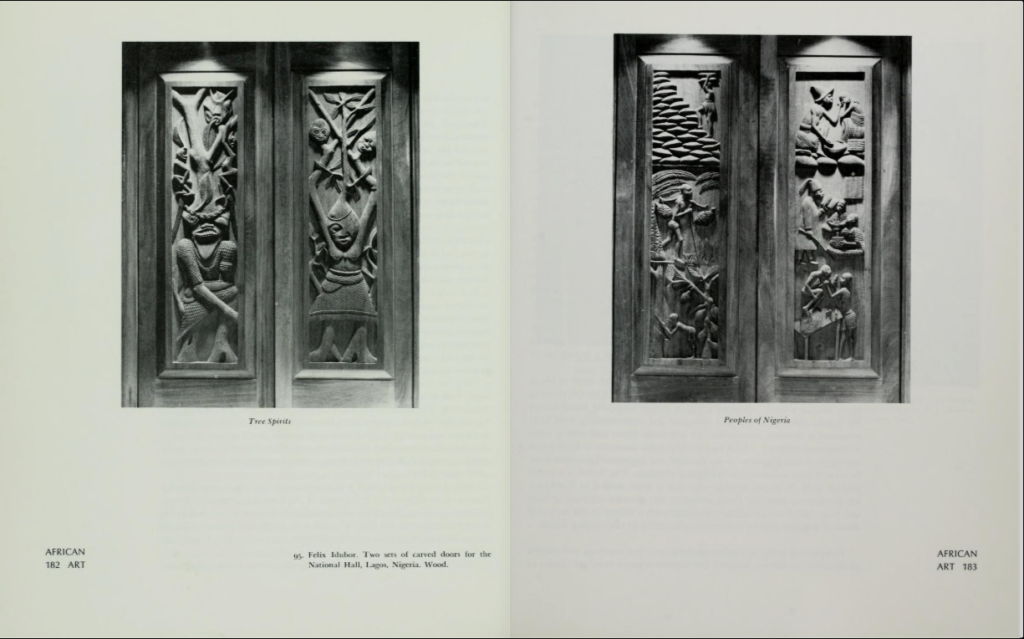
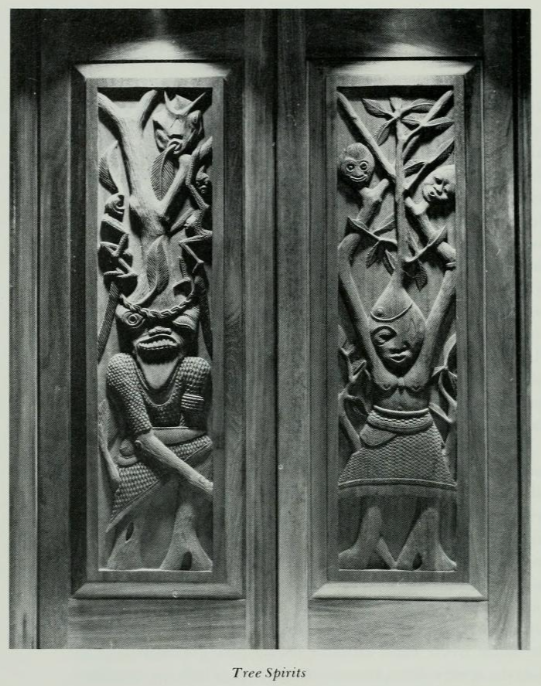
Idubor’s more successful works certainly are his carved wood doors, the most interesting of which are a series of eighteen executed for the National Hall (Parliament Assembly Hall) in Lagos in 1960. Each of three wide entrances to the debating chamber has three sets of double doors, each door carved with a long rectangular moderately high relief. The entire series begins at the left side with representations on two doors of fantastic Nigerian tree spirits, revealing the sculptor’s creativity in handling imaginary subjects (Plate 95a). This kind of creativity with fantastic subjects is often found in traditional African sculpture. The main subject matter of these reliefs, however, are the past and present activities of people from all over Nigeria. Various native industries, such as cloth dyeing and flour making, as well as aspects of ceremonial life of the major tribal groups are represented.
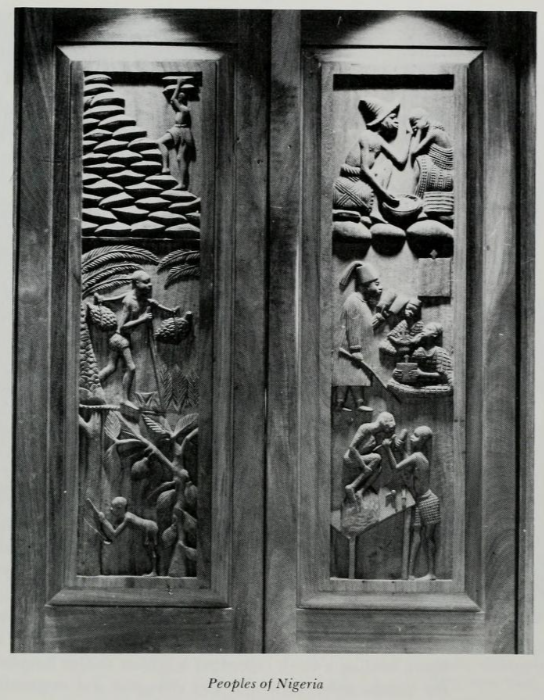
Fifteen of the National Hall doors illustrate three scenes each. In the two doors shown in Plate 95b, from top to bottom, the scenes represented are: left, loading cocoa bags, carrying palm nut kernels, and tapping a rubber tree; right, a ritual bathing scene, education in a Moslem school, and a wood sculptor at work. These doors are characteristic of Idubor’s relief style. All figures and objects with few exceptions are seen either in frontal or profile view, proper scale relationships are disregarded, there is a marked predilection for decorative pattern both in compositional interpretation and in details of design.
The sculptor’s representation of an African carver, shown on the right bottom panel of Plate 95b, is noteworthy for it reveals a sculptor wearing a European undershirt and working with a European chisel on a European-style figure placed on a table. Idubor, himself, however, works in a more traditional African fashion, that is, seated on the ground with the carving held between his legs.
The last doors in the National Hall series portray, respectively, the arrival of the British in Nigeria and the celebration of Independence, October First, 1960. The latter is the more effective of the two. Joyously dancing figures carry aloft the letters and numerals of the date, which are arranged to fill the entire panel and to form a unified effect that is lacking in most of the other doors. Moreover, the liveliness and informality of the poses in this relief contrast with the relatively static quality of many of the figures in some of the other panels.
Felix Idubor has achieved a wide reputation and must, after Ben Enwomwu, be considered the best known of Nigeria’s new artists. He has executed a number of important commissions while working in several differing styles, the most successful being his relief style. In the best of these reliefs he shows imagination and inventiveness allied with a sureness of technique and composition.
95. Felix Idubor. Two sets of carved doors for the National Hall, Lagos, Nigeria. Wood
… Independent artists in English speaking areas thus represent two distinct generations: (1) Sekoto, Ampofo, and Enwonwu began their art careers in the 1940s and have worked and exhibited steadily since then, producing a large body of work and establishing international reputations. Their works are at times relatively conservative in style. (2) Idubor, Emokpae, and Afewerk, younger-generation artists, first attracted attention in the 19505. Although Afewerk and Idubor have had difficulty at times in breaking away from their early styles, academic and souvenir, respectively, they have attempted in several works to create in an advanced modern style. Emokpae’s paintings, too, with their geometrically stylized figures, interest in design, and extreme textural variations, are essentially modern in conception.
These independent artists, together with the artists intimately connected with African art schools either as students or instructors, have contributed greatly to the new African art. Although they are distinctly in the minority. the independent artists are for several reasons significant in any discussion of this new work. The earliest known is the Cameroun painter Ibrayima Njoya, while other artists, such as Sekoto and Enwonwu, are well known outside Africa. Moreover, the younger generation of independent artists, like Ma langatana, N’Diaye, and Emokpae have developed styles which indicate clearly the strength of their creativity and originality.
Chapter 9: Summary
…During the next decade, 1950-1960, African art developed at an accelerated pace. Several new schools were founded: the Poto-Poto School in Brazzaville, People’s Republic of Congo; the Nigerian art departments now at Ahmadu Bello University, Zaria, and Yaba Technical Institute, Lagos; the Académie des Beaux-Arts in Lubumbashi: the Fine Arts School, Addis Ababa; and the Ecole Nationale in Dakar, Senegal. Graduates of schools founded in the 1930s and 1940s – such as Salahi, Shibrain, Kofi, Bela, Pilipili, Mwenze, and Mensah-began teaching a new group of students who were often only a few years younger than their teachers. These years also saw the emergence to prominence of Felix Idubor and Afewerk Tekle, artists work-ing independently in Nigeria and Ethiopia, respectively…
…Some of the younger artists, resembling the older painters and sculptors, are eclectic in style. C. Uche Okeke, Idehen, Malangatana, Kofi, Salahi, Shibrain, and Idubor often draw for inspiration on the arts of both Africa and the West. Most of these new artists – Akolo, Grillo, Nwoko, Simon Okeke, Onobrakpeya, Gebre Kristos, Skunder, N’Diaye, Tall, and Emokpae – have, however, developed styles related in a general way to Western twentieth-century art. Like their counterparts in modern Europe and America, they are interested in abstraction of form, design, and composition and the use of color in a nondescriptive manner. …
Bibliography
“A New Carver (Felix Idubor of Nigeria)” Nigeria Magazine, no. 41 (1953). 22-27.
“Felix Idubor” African Arts, 11, no. 1 (Autumn 1968), 30-35.
